
Fire Safety
Certification Course on Fire Safety
Kaushalya – The Skill University, Government of Gujarat
Course Overview
A specialized, industry-focused fire safety program
The Certification Course on Fire Safety is designed to develop the knowledge, skills and practical competencies required to prevent, detect and respond effectively to fire emergencies in workplaces. Approved by Kaushalya – The Skill University (KSU), Government of Gujarat, the course adopts a competency-based approach that combines theoretical concepts with extensive practical training.
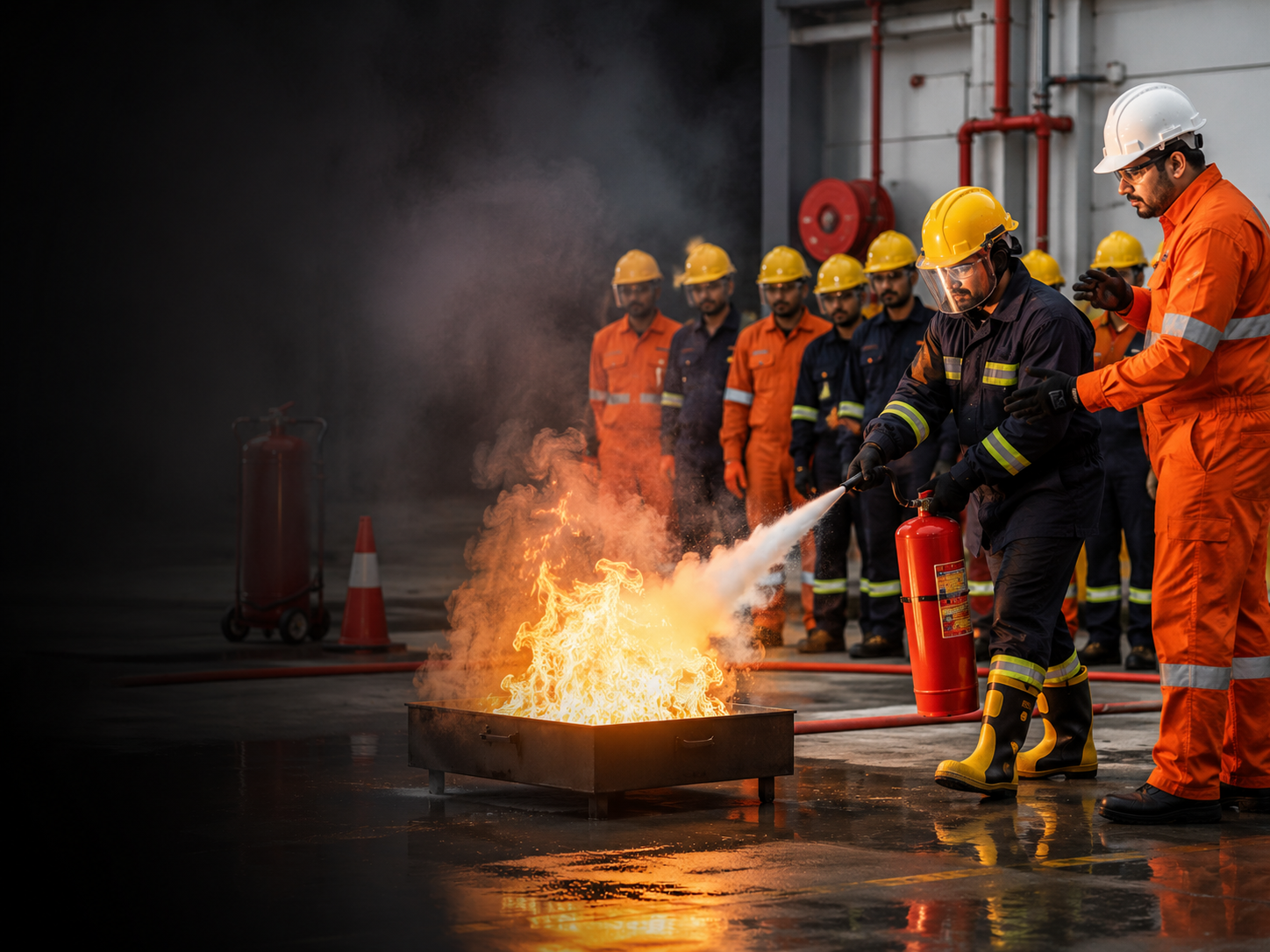
The curriculum integrates classroom sessions, live demonstrations, practical exercises, mock drills and hands-on training with firefighting equipment and emergency response systems. Participants learn to identify fire hazards, select fire protection measures, operate portable extinguishers and coordinate emergency evacuation.
Why Fire Safety Matters
Fire safety is a critical component of occupational health and safety, playing a vital role in protecting lives, property, business continuity and the environment. The course emphasizes proactive risk management and preparedness to minimize the impact of fire incidents across industrial, commercial, institutional and residential settings.
Training Methodology
- Classroom sessions on fire science and codes
- Live fire demonstrations and mock drills
- Hands-on use of portable fire extinguishers
- Fixed system walkthroughs — hydrants, sprinklers, alarms
- Emergency response and evacuation drills
- Case studies from industrial fire incidents
Key Topics
Learning Outcomes with Assessment Criteria
| Subject / Module | Assessment Criteria |
|---|---|
| Basics of Fire Science | Explain fire triangle and fire tetrahedron. Identify elements required for fire ignition and propagation. |
| Classification of Fire | Identify different classes of fire (A, B, C, D, K) and select appropriate firefighting methods. |
| Fire Hazards Identification | Recognize common fire hazards in industries, offices and residential areas. |
| Fire Prevention Techniques | Demonstrate understanding of fire prevention practices and safe storage of flammable materials. |
| Fire Extinguishers | Identify types of fire extinguishers and demonstrate correct operation using the PASS technique. |
| Fire Detection & Alarm Systems | Describe working principles of smoke detectors, heat detectors and fire alarm systems. |
| Fire Protection Systems | Explain basic components of hydrant systems, sprinklers and fire suppression systems. |
| Emergency Response & Evacuation | Demonstrate correct emergency response, evacuation procedures and fire drill participation. |
| Personal Protective Equipment | Identify and properly use fire safety PPE such as helmets, gloves and fire suits. |
| Basic Fire Risk Assessment | Conduct a basic fire risk assessment and recommend preventive measures. |
Basics of Fire Science
Explain fire triangle and fire tetrahedron. Identify elements required for fire ignition and propagation.
Classification of Fire
Identify different classes of fire (A, B, C, D, K) and select appropriate firefighting methods.
Fire Hazards Identification
Recognize common fire hazards in industries, offices and residential areas.
Fire Prevention Techniques
Demonstrate understanding of fire prevention practices and safe storage of flammable materials.
Fire Extinguishers
Identify types of fire extinguishers and demonstrate correct operation using the PASS technique.
Fire Detection & Alarm Systems
Describe working principles of smoke detectors, heat detectors and fire alarm systems.
Fire Protection Systems
Explain basic components of hydrant systems, sprinklers and fire suppression systems.
Emergency Response & Evacuation
Demonstrate correct emergency response, evacuation procedures and fire drill participation.
Personal Protective Equipment
Identify and properly use fire safety PPE such as helmets, gloves and fire suits.
Basic Fire Risk Assessment
Conduct a basic fire risk assessment and recommend preventive measures.
Who Should Attend
- Safety Officers and Fire & Safety Professionals
- Industrial Workers and Supervisors
- Facility Managers and Maintenance Personnel
- Emergency Response Team (ERT) Members
- Security Personnel and Engineers
- Students seeking a fire safety specialization
Career and Workplace Benefits
On successful completion, participants can identify fire hazards, conduct basic fire risk assessments, implement preventive measures, safely operate firefighting equipment, participate in emergency response and help build a strong fire safety culture. The certification enhances employability while supporting organizations in achieving safer workplaces and compliance with statutory fire safety requirements.
Take the next step
Start Your Journey Towards a Safer Career
Explore professional fire safety, industrial safety and occupational health training programs at ICAT.